How to Teach Your Child to Spot Fake News (Before It's Too Late)
Last month, a school in Texas sent parents an urgent email. A viral video showing their principal making racist comments had been circulating on social media. Parents were furious. Local news picked it up.
The video was a deepfake. Completely fabricated. But by the time the truth came out, the damage was done.
This isn't a fringe scenario anymore. It's the new normal.
The misinformation problem is accelerating
AI can now generate realistic videos of people saying things they never said. It can create news articles indistinguishable from real journalism. It can fabricate research papers complete with citations and data tables.
Adults struggle to tell the difference. For children who are still developing their ability to evaluate information, it's nearly impossible.
And here's what makes this urgent: your child is consuming more unfiltered content than any generation in history. TikTok, YouTube, Reddit, group chats. The information hits them before any adult has a chance to vet it.
The old advice ("check the source") doesn't cut it anymore. The source looks legitimate. The content looks professional. The tell-tale signs of misinformation have gotten much harder to spot.
Why "media literacy" classes aren't enough
Most schools that teach media literacy focus on surface-level checks. Who published this? Is it a .gov or a .com? Does the headline match the article?
Those checks catch the obvious stuff. They don't catch the sophisticated stuff. And the sophisticated stuff is what's actually reaching your child's phone.
Real critical evaluation means understanding how arguments work. Recognizing when someone is appealing to emotion instead of evidence. Noticing when data is presented in a misleading way. Identifying the difference between correlation and causation.
These aren't advanced skills reserved for college students. A 10-year-old can learn to spot a false equivalence. A 12-year-old can learn to identify cherry-picked statistics. But someone has to teach them explicitly. And right now, almost nobody is.
Three things you can do at home
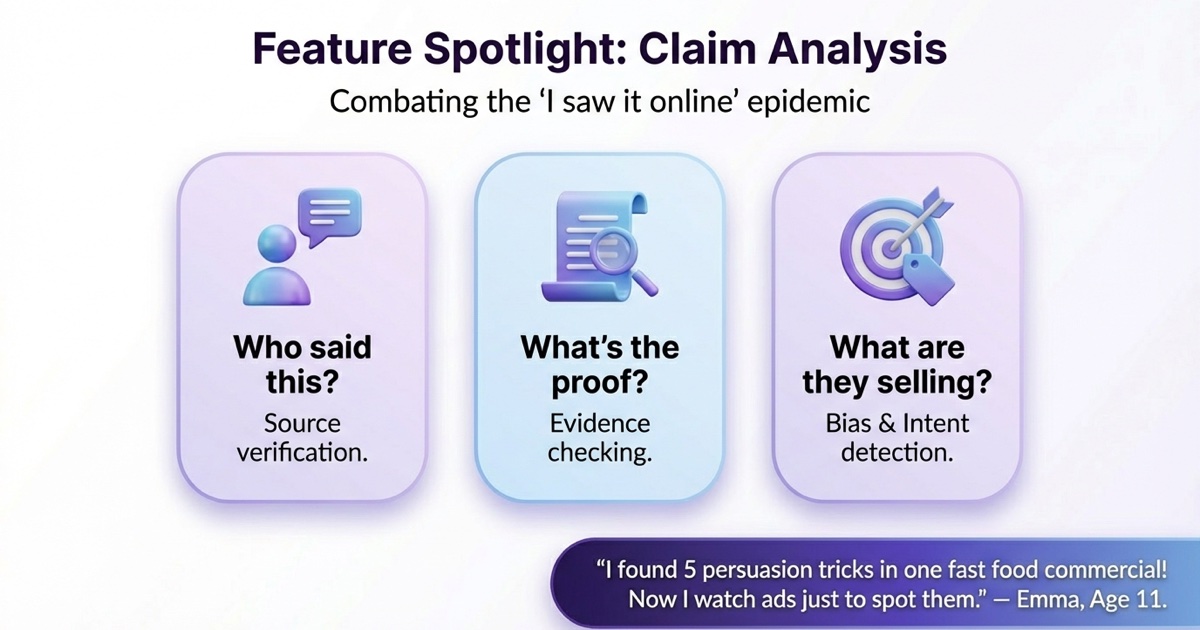
1. Play "spot the trick." When you're watching a commercial or scrolling past an ad together, ask: "What are they trying to make you feel? What did they leave out?" This builds the habit of questioning persuasion rather than absorbing it. Start with ads because they're low stakes, then graduate to news stories and social media posts.
2. Practice the "says who?" reflex. When your child shares a fact they learned online, respond with: "That's interesting. How do we know that's true?" Not in a dismissive way. Genuinely curious. You're training them to trace claims back to evidence before accepting them. The goal is to make this feel natural, not interrogative.
3. Show them how you get fooled. Find a time you believed something that turned out to be wrong. Talk through what made it convincing and what you missed. Children learn more from watching adults model intellectual humility than from any lecture about critical thinking. If they see that smart people get tricked too, they're more likely to slow down and evaluate rather than just react.
These conversations matter. But they're ad hoc. They happen when you remember, which isn't often enough. And there's no way to measure whether your child is actually getting better at evaluation over time.
Building the skill systematically
Cogito Coach's Argument Analyst module exists for exactly this reason. It teaches children to evaluate claims and arguments using 48 real investigation techniques drawn from formal logic and rhetoric.
Your child picks a claim or topic. The AI walks them through analyzing it: What's the evidence? What techniques is the author using to persuade? Are there logical fallacies? What's missing from the argument?
After each session, you get a report showing which techniques your child identified, how deeply they analyzed the argument, and where they're improving. You can see their progress over weeks and months, not just guess.
It's not a quiz. It's not a game dressed up as learning. It's real practice for a world where the ability to evaluate information is no longer optional.
The children who learn to question what they see will navigate that world with confidence. The ones who don't will be shaped by whoever is best at manipulating them.
Your child reads claims online every day. Can they spot the tricks?
Argument Analyst teaches 48 real techniques for evaluating claims and spotting manipulation. Pick any headline, article, or ad and let them investigate.
Try Argument Analyst FreeOne practical thinking tip every week.
Takes 2 minutes to read. No spam, no fluff.