Oral Defenses Are Back Because the Case Memo Stopped Proving Anything. What Should Replace It at Scale?
Picture the memo. Four pages, clean structure, the right framework applied in the right order, a recommendation with three supporting reasons and one honestly stated risk. Five years ago you would have given it an A without much thought.
This term you read it twice, put it down, and realized you have no idea whether the student who submitted it could defend a single paragraph of it if you asked one follow-up question.
That feeling now has an institutional name. In September, Times Higher Education reported on a GMAC study built on interviews with the deans of ten European business schools. Its summary was blunt: AI "has broken traditional evaluation," because students can instantly generate competent responses to case studies. INSEAD's Francisco Veloso called the traditional case study assessment method "dead." Peter Todd at Imperial said assessment had moved towards "the performative arts," and added that short of a locked room and a pencil, "you cannot be sure what you are getting anymore."
The responses are already in place. HEC Paris alternates between "machine off" and "machine on" assessments. Frankfurt School has reinstated oral exams and final presentations. Nova SBE has extended thesis defences.
I think the deans are right about the diagnosis. I think the oral defense is the right instinct. And I think it is the wrong answer for a 90-student section, which is where most of this has to work.
What actually broke
The case method did not fail. Nobody is arguing that students learn less from working through a real company's real dilemma. What failed is narrower and older than AI: the habit of treating the written output as evidence of the reasoning that produced it.
A case memo was always a proxy. We never graded the memo for its own sake. We graded it because producing a good one used to require doing the thinking, so the document was a cheap, reliable trace of the work behind it. That relationship held for a century because there was no other way to make the document.
Now there is. The memo still looks like evidence. It just stopped being attached to anything.
This matters because it tells you what a fix has to do. Making the memo harder to generate, with more obscure cases or stricter honor codes or detection software, tries to restore a link that is gone. The fixes that work, and the oral defense is one, all do the same thing: they stop looking at the output and start watching the reasoning happen.
Why the oral defense works, and why it will not scale
An oral defense works because of the examiner, not the format. Someone who knows the material asks why. Then asks what would change the student's mind. Then picks the weakest sentence in the recommendation and leans on it. A student who did the thinking can follow that conversation anywhere. A student who borrowed the conclusion runs out of road in about two questions. Nova SBE put the time it takes to spot AI-written work in a defence at about 30 seconds, and anyone who has run a viva knows the feeling.
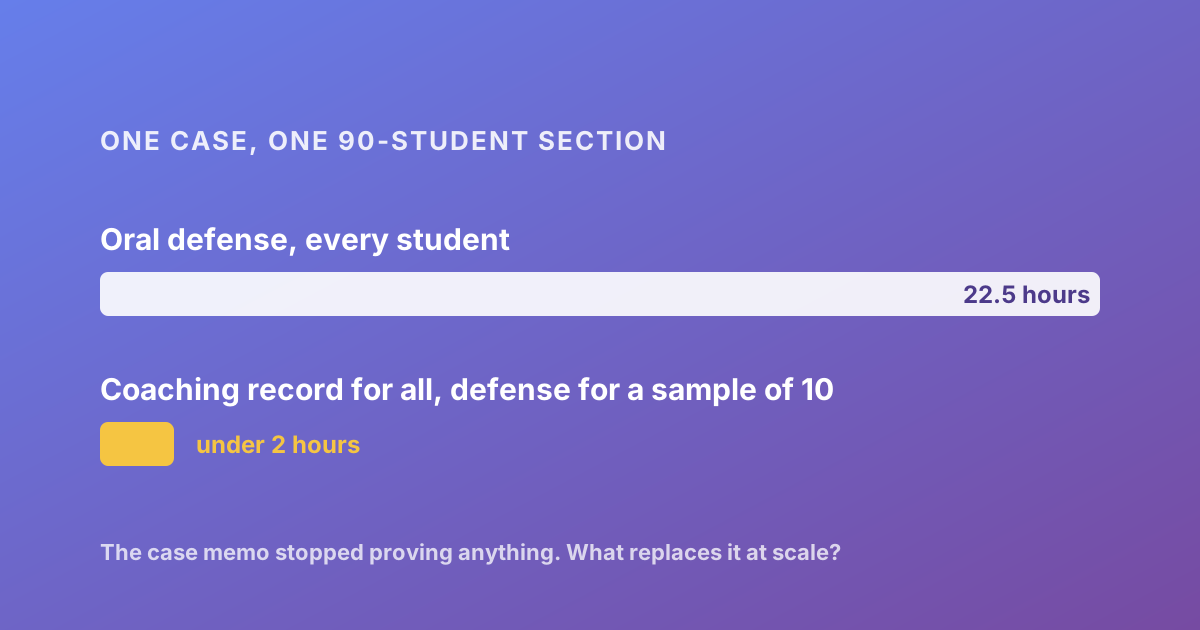
Now do the arithmetic for one assignment in one section. Ninety students at fifteen minutes each is twenty-two and a half hours of examination, before scheduling, before the student who is sick that week, before writing anything down. Run three sections of the course and it is most of a teaching week. Add an adjunct who covers one of those sections and you have two examiners applying two standards, with no way to compare them afterward.
There are quieter costs too. Oral exams reward fluency in the language of instruction, and business school cohorts are heavily international. A brilliant analyst working in her third language can look weaker in a ten-minute defense than she is. And the record an oral leaves behind is usually a grade and a few lines of notes, which is thin if a student appeals or an accreditor asks how you know.
None of that is an argument against oral defenses. It is an argument that they cannot be the whole system. Schools reaching for them across every course are paying for rigor with faculty time that was never budgeted, and that bill comes due in the second term, when the novelty is gone and the grading load is not.
A field reaching for fixes without a shared picture
There is a second piece of evidence worth putting next to the GMAC study. In October, AACSB published its 2026-27 Deans Survey. Out of 49 typical dean activities, AI in education and research ranked second in priority. It also showed the largest gap of any activity between how much deans prioritize it and how proficient they rate themselves: 4.54 against 3.41.
My reading of that gap, and it is a reading, not a finding: most schools are redesigning assessment before they have agreed on what good reasoning in an AI-saturated course looks like when a student demonstrates it. That is why the responses look like a retreat. Oral exams, pen and paper, machines off. They are the formats everyone already trusts. Reaching for the familiar is what sensible people do when the target is unclear.
The risk is that the retreat becomes the strategy. A program that moves every high-stakes assessment into a room with a pencil has protected its grades. It has also stopped preparing students for the place they will actually work, which has the machine on all day.
The goal was never AI-proof
MIT's ad hoc committee on AI in teaching and learning reached a similar point from a different direction. Its August report, as covered by Inside Higher Ed, urged the institute to "consider what role grades play in our overall system" and to explore alternatives such as competency-based approaches. One commentary on the report put the shift well: assessment becomes "less about one artifact and more about evidence of learning."
Evidence of learning is a different target from an AI-proof assignment. An AI-proof assignment is defensive. It asks how to stop the machine from doing the work. Evidence of learning asks how to see the work being done, by whom, and how well, with or without a machine in the room.
Seen that way, the oral defense is one method for producing evidence of learning, and its expensive ingredient is a live interlocutor who pushes back. The question for a program is whether that ingredient can be provided at the scale of a whole cohort, on every case, without consuming the faculty.
I think it can, and I should say plainly that this is the thing my company builds, so weigh what follows accordingly.
What the scalable version looks like
Keep your case. Keep your framework and your question. After the case discussion, each student works through a structured coaching session on that same case. The coach does what a good examiner does. It asks the student to commit to a position. It asks why. It picks the weakest link and asks what would make the recommendation wrong. It does not supply the answer, and it does not accept the first one.
Take a standard inventory question: if prices are rising, why would any company still choose FIFO? A student who has memorized that FIFO reports higher income under inflation will say so in one sentence. The coach then asks who benefits from higher reported income, what it costs in tax, and why a market that can read the footnotes would be fooled. Twenty minutes later the student has either built the argument or shown precisely where it stops. Both outcomes are useful, and both are on the record.
That record is the part a memo never gave you. Every turn is kept, dated, and scored against a rubric, so the result is an individual account of how this student reasoned through this case on this date. You can read it in a few minutes. You can compare students across sections taught by different people, because the same rubric applied to all of them. And you have something to show when a dean, an accreditor, or a student appealing a grade asks how you know.
"Can't they just paste the pushback into ChatGPT?"
Yes. Nothing short of a locked room makes cheating impossible, and I am not going to pretend otherwise. What changes is the cost. Faking one memo takes a single prompt. Faking twenty turns of responsive reasoning means reading each challenge closely enough to relay it, then reading each answer closely enough to know whether it addresses the challenge. A student who does that carefully for twenty minutes has done a fair share of the thinking anyway. A student who does it carelessly leaves a transcript that does not hold together, and that is visible.
Which suggests the best use of the oral defense at scale is as an audit rather than a census.
Use the oral defense as a sample
Auditors do not re-check every transaction. They test a sample and compare it against the record. The same logic works here. Pick eight or ten students per section. Read their session record first, then ask each of them to defend two specific moments from it for ten minutes. If the conversation in the room matches the reasoning in the record, you have good reason to trust the records you did not sample. If they diverge, you have learned something specific about one student, and you have a conversation to have with them.
Ten students at ten minutes is under two hours per section, against twenty-two and a half for examining everyone. The rigor of the oral survives. The faculty week survives too.
What this asks of faculty
Less than the alternatives, as it turns out. You do not have to rebuild the course or write new cases. Your cases, your frameworks and your voice are exactly the material that makes a coaching session worth doing. Generic scenarios produce generic reasoning, and the discipline is where the judgment lives.
What changes is where your attention goes. Instead of reading ninety memos that all look competent, you read the moments where students got stuck, and you sample the ones you want to hear defended in person. That is closer to how you would choose to spend the time if the grading load did not decide for you.
If you want the mechanics, here is how a session runs. If you are thinking about the curriculum question one level up, I wrote about what fills the AI coursework gap in business schools in August.
The question I would bring to the next faculty meeting
The deans in the GMAC study are not wrong to bring back the oral defense. They are reaching for the one format that still shows reasoning happening in front of them, which is exactly the right thing to want.
But wanting to see the reasoning and being able to see it for every student, on every case, every term, are different problems. Only the second one is the job.
So here is the question I would put on the table. If your program had to show an accreditor or a dean's cabinet proof that your students can reason through a case, rather than produce one, what would you hand them today?
Your cases. Our practicum. A record of how each student reasoned.
Cogito adds a scored coaching session to the cases you already teach. You keep your content and your voice. Every student leaves a dated Coaching Session Report showing how they reasoned, ready for you to sample, review, or put in front of an accreditor.
Discuss a faculty pilotOne practical thinking tip every week.
Takes 2 minutes to read. No spam, no fluff.