42% of Leading Business Schools Require No AI Coursework. What Should Fill That Gap Before the Next Ranking Cycle?
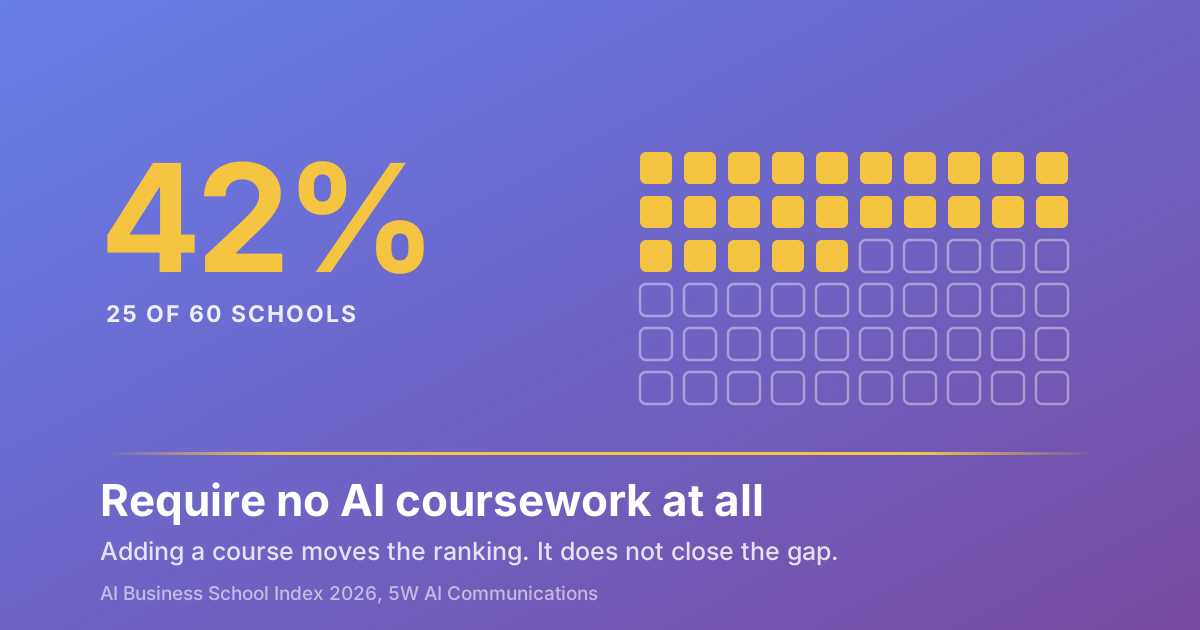
Somewhere this month a professor opened a new ranking table, scrolled down to find their own school, and discovered it sits in the 42% that require no AI coursework at all. Then came the email from the associate dean. Usually two lines, usually a link, usually some version of what are we doing about this.
If that was you, I would like to make the next part easier. Not by telling you what to add. By being straight about what the number says, what it does not say, and which of the obvious responses will look excellent in twelve months while changing nothing about what your graduates can do.
Where the number comes from
The figure is from the AI Business School Index 2026, published on August 12, 2026 by 5W AI Communications, the AI division of the New York public relations firm 5W Public Relations. Poets&Quants covered it the same day. The specific finding: of 60 business schools across 14 countries, 25 require no AI coursework at all. Twenty-five of sixty is 42%. Stanford GSB came out on top, with roughly 36 AI-integrated courses against a median of two.
Now the caveat, because this is a publication about judgment and skipping it here would be a bit rich. The index is a PR agency's product. Poets&Quants said plainly that its methodology, data sources and scoring model have not been independently verified or peer-reviewed. Dimension-level data is available on request rather than published. The composite scores carry a stated margin of roughly plus or minus 2.5 points at a 95% confidence interval, and the citation-share dimension leans on US-based AI engines, which the report itself acknowledges probably disadvantages schools like Tsinghua.
None of that makes the finding useless. It makes it worth reading carefully, which is a different thing.
Twenty-five of sixty is the least model-dependent number in the whole report. A school either requires an AI course or it does not, and you could check any single entry yourself in about ten minutes. That claim survives a weak methodology. The rankings built on six equally weighted dimensions, with a margin of plus or minus 2.5 points, do not survive it nearly as well. Those two things arrived in the same press release and they do not deserve the same confidence.
Which is worth separating before anyone reorganises a curriculum around a league table. If your school moved four places, that is inside the noise. If your school requires no AI course, that is just true.
What is about to happen, and why it will not work
Here is my prediction for the next twelve months, and it is not a cynical one.
Schools in the 42% will add a required AI course. Some will announce a concentration. A few will appoint a director of AI in the curriculum, and the appointment will be a good one. These are all real pieces of work done by serious people, and every one of them moves a curriculum-integration score.
The question worth putting to the curriculum committee is not whether to do them. It is narrower and more uncomfortable: after a graduate completes the new requirement, what can they do that they could not do before?
Because there is a second number in the same index that I find far more useful than the 42%, and almost nobody is quoting it.
Across the schools measured, coursework about AI strategy outnumbers coursework about AI implementation by roughly nine and a half to one.
That ratio is the actual diagnosis. Business schools are not ignoring AI. They are teaching it the way business schools teach most things, as a subject to hold an informed position on. Graduates leave able to discuss where AI creates competitive advantage, where it compresses margin, which functions it reshapes first. That is genuinely valuable and I would not cut a minute of it.
What they mostly cannot do is look at the specific output on the screen in front of them and tell whether it is wrong.
Knowledge and judgment are not the same purchase
You already know this, which is the awkward part of writing it down. It is why your programs run cases instead of only lectures. It is why the capstone exists. It is why you make students defend a recommendation to a room full of people who interrupt, rather than submit it quietly on paper.
The entire apparatus of professional education is built on one observation: some capabilities only become real under performance conditions. Nobody learns to negotiate from a reading list. You would not certify a clinician who had only ever been examined in writing.
AI evaluation belongs in that category, and it is currently being taught as though it belongs in the other one.
A student can recite that language models fabricate citations. They can define hallucination, name the mechanism, pass a quiz on it. Then put a confident, fluent, well-formatted, wrong answer in front of that same student at 11pm, at the end of a long assignment, in a subject where they are not yet expert, and watch what happens.
The gap between those two moments is not a knowledge gap. It is a rehearsal gap. The student has never once been in the room where the AI was persuasive and wrong and something depended on noticing.
A required course closes the first gap. It does very little to the second.
So what actually fills it
The same thing that fills it everywhere else in professional education. Repeated practice under conditions that can go wrong, with someone pushing back, and a record of how the student reasoned.
Three properties do the work, and they are worth naming because they are what separates a practicum from an assignment.
It has to push back. A student who concludes "the AI is probably right here" should be asked why, then asked what would change their mind, then asked what they would need to see to be confident. An exercise that accepts the first answer has taught, very efficiently, that the first answer is enough. Most AI assignments accept the first answer.
It has to run on your material. Generic AI ethics scenarios produce generic reasoning. A brand strategy student interrogating an AI's segmentation logic against a real positioning brief is doing the actual work. The same student evaluating a made-up chatbot in a made-up company is doing a comprehension exercise with AI decoration. The discipline is where the judgment lives, which means the content has to be yours.
It has to leave evidence. Not a completion mark. A record of what the student said, where the reasoning held, where it broke, and what they should practise next. Without that you may have taught the thing beautifully and you have no way to show anyone that you did. Including yourself, next year, when you want to know whether the redesign worked.
That last one is the piece most programs are missing, and it is the piece that turns a curriculum decision into something you can defend outside the building.
"But we already let them use it"
This is the most common response I get from faculty, and it is usually said with some impatience, because the person saying it has already done more thinking about AI than their institution has.
Permitting AI is not the same as teaching evaluation. An AI policy governs conduct. It says what students may use, when they must disclose it, what counts as their own work. Those are necessary and most programs have now written them.
But a policy is a rule about behaviour, and judgment is a habit under pressure. Letting students use AI on an assignment produces exactly one reliable outcome: they will use it. Whether they interrogated the output or accepted it is invisible in the submitted work, because good AI output and carefully verified AI output look identical on the page. That is the whole problem in one sentence.
You can only see the difference if you watch the reasoning happen. Which means the evaluation has to be its own activity, with its own record, rather than an assumption you make about what happened in a student's browser at midnight.
The good news is that you already own the expensive part. The cases, the briefs, the datasets, the frameworks your program spent years building are precisely the material that makes AI evaluation specific rather than generic. What is missing is not content. It is a place to practise against it and something that records how it went.
Back to the ranking cycle
Which brings us to the part of this I find genuinely difficult.
If the goal is to move out of the 42% before the next index publishes, a required course does it. Cleanly, visibly, and in time. That is a legitimate thing to want. Deans are measured against instruments they did not design and cannot opt out of, and pretending otherwise is a luxury available mainly to people who have never sat in that meeting.
But look at what is being measured. Course counts. Whether a requirement exists. These are the cheapest possible signals to satisfy, which is exactly why an index built by a PR firm reaches for them. Everyone optimises the same dimension, everyone's number improves, and the distribution reshuffles without a single graduate becoming better at catching a plausible wrong answer.
What no ranking currently measures is per-student evidence that the graduate can actually do it.
My guess, and it is a guess, is that employers ask for that before rankings do. Recruiters in regulated sectors are already being asked by their own risk and audit teams what their people can do with AI, and "we hired from a school with an AI concentration" is not going to survive that conversation for long. The schools that can answer with something per-student and specific will find they built the right thing slightly early.
The question I would actually ask
If you are in the 42%, add the course. I mean that. It is a reasonable response to a real signal and I am not going to be precious about the fact that a PR agency generated it.
But do not let it be the whole answer, because the ratio in that same report tells you it will not be. Nine and a half to one is the gap. Not the 42%.
So here is what I would put in front of the next curriculum committee, instead of a list of proposed electives.
If a recruiter asked you to demonstrate that your graduates can catch a confident, plausible, wrong AI answer in your discipline, what would you hand them?
If the honest answer is a syllabus, you have found the actual gap. And it will still be there next August, whatever the index says.
Your course. Our practicum. Scored evidence per student.
Cogito hosts faculty-authored courses and adds the coaching practicum after each lesson. You keep your content and your voice. Every student leaves a session with a scored Coaching Session Report you can put in front of a program director.
Discuss a faculty pilotOne practical thinking tip every week.
Takes 2 minutes to read. No spam, no fluff.